
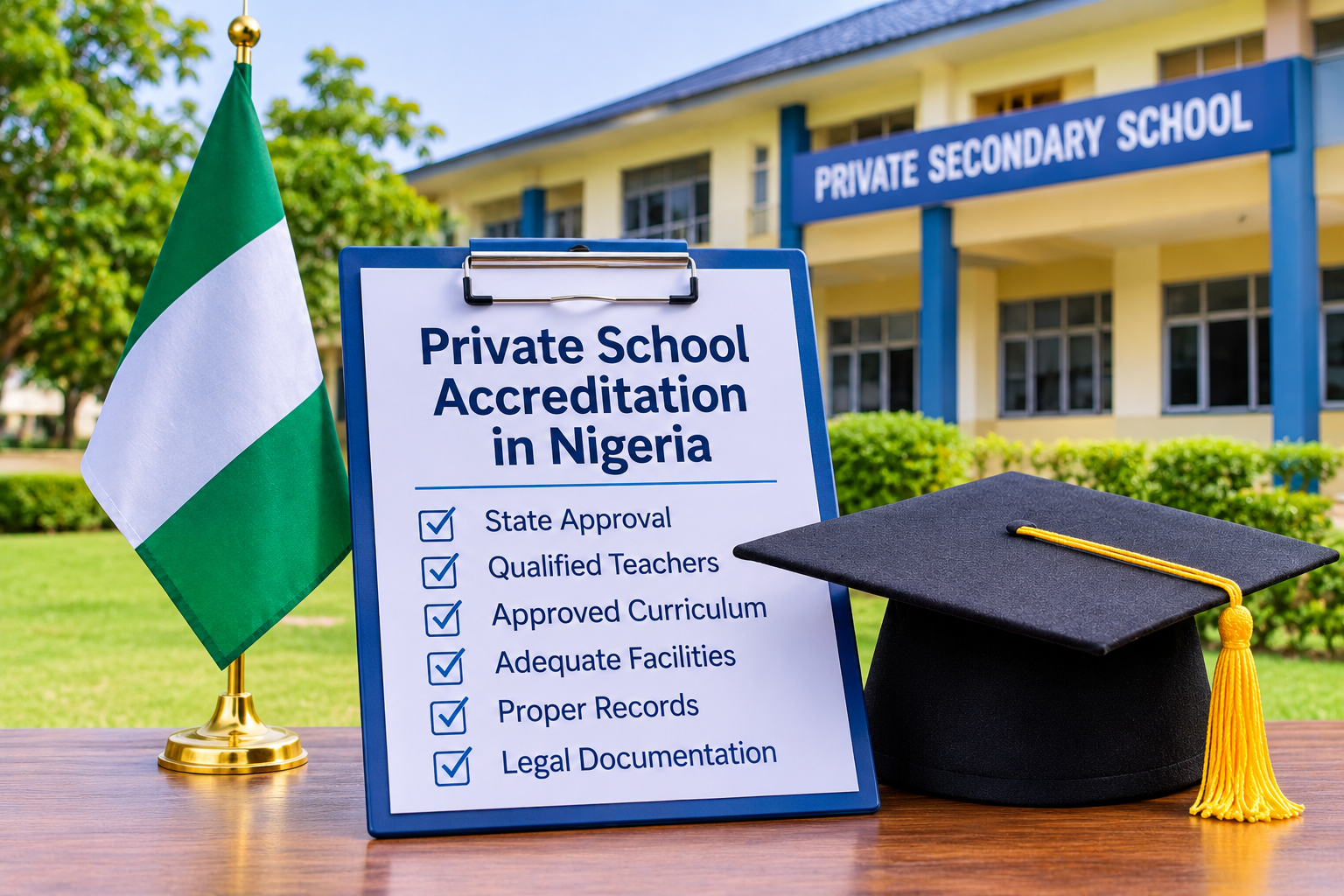
Private school accreditation in Nigeria involves meeting the registration and operating requirements established by the relevant State Ministry of Education. Although federal education agencies develop national standards for areas such as curriculum, teacher registration and senior secondary education, state authorities are responsible for inspecting and approving private schools within their jurisdictions.
The requirements generally cover school facilities, qualified teachers, curriculum implementation, administration, safety and legal documentation. Proprietors must understand these requirements before establishing a school or applying for official registration.
This guide explains the key areas of compliance private school proprietors should consider and identifies the relevant education authorities.
Table of Contents
ToggleWhat Are the Mandatory Requirements for Private School Accreditation in Nigeria?
KEY TAKEAWAY
- Register with your State Ministry of Education. Follow the application process and complete the required inspection to obtain official approval.
- Provide suitable school facilities. Prepare classrooms, laboratories, libraries, ICT facilities, sanitation facilities and appropriate safety equipment.
- Employ qualified teachers. Ensure that teachers have relevant academic and professional qualifications for the subjects and levels they teach.
- Implement the approved curriculum. Follow the applicable Nigerian curriculum and meet relevant educational requirements.
- Maintain proper governance and records. Keep accurate administrative, financial, staff and student records.
- Prepare legal and site documentation. Obtain the relevant business registration documents, approved building plans and other documents required by your state.
Private school proprietors must address several areas when preparing their institutions for registration and inspection.
Understanding these requirements can help proprietors prepare for inspections and avoid unnecessary delays during the registration process.
What Is Private School Accreditation?
Accreditation is formal recognition by a competent authority that an educational institution meets specified educational and operating standards.
For private schools in Nigeria, approval generally involves state-level registration, inspection and compliance with applicable education regulations. Schools may also need separate recognition or approval to operate as authorised external examination centres.
Different education agencies have distinct responsibilities. The National Senior Secondary Education Commission (NSSEC) is responsible for regulating and setting standards for senior secondary education. The Nigerian Educational Research and Development Council (NERDC) develops the national curriculum, while the Teachers Registration Council of Nigeria (TRCN) regulates the teaching profession.
State Ministries of Education handle the registration and inspection of private schools within their jurisdictions.
Who Approves a Private School: The Federal or State Ministry?
State Ministries of Education are responsible for registering and inspecting private schools within their respective states. Federal education agencies establish national policies and standards, but they do not replace the state registration process.
Therefore, anyone planning to establish a private school should begin by contacting the State Ministry of Education where the school will operate.
The Ministry can provide information about application procedures, inspection requirements, registration fees, required documents and applicable operating standards.
Proprietor's Tip
Request your State Ministry's current private school registration checklist before investing in land, buildings or other facilities. Requirements and procedures may differ between states.
Requirements for a Private Secondary School
Requirement 1: Classrooms, Class Size and Facilities
A private secondary school must provide a suitable learning environment that supports effective teaching, student safety and practical learning.
Classrooms should be adequately spacious, well-lit and ventilated. They should also have appropriate furniture, including student desks and chairs, as well as teaching equipment such as whiteboards.
Depending on the school’s programmes and applicable state requirements, the following facilities may also be necessary:
- Science laboratories for Physics, Chemistry and Biology.
- An ICT laboratory with appropriate computers and internet connectivity.
- Technical and vocational workshops.
- A functional, well-stocked library.
- Sports fields and recreational spaces.
- Accessible fire safety equipment and first-aid kits.
- Clearly identified emergency exits.
- Suitable toilet and sanitation facilities.
- Safe access routes and adequate environmental hygiene.
Proprietors should obtain the applicable facility and infrastructure standards from their State Ministry of Education before construction or renovation.
Requirement 2: Qualified and Registered Teachers
Employing qualified teachers is an important part of operating a private school. Teachers should have relevant academic and professional qualifications for the subjects and classes they handle.
The Teachers Registration Council of Nigeria (TRCN) regulates the teaching profession and is responsible for teacher registration and professional standards.
Private school proprietors should therefore review the qualifications and registration status of their teaching staff and ensure that they comply with applicable requirements.
Teachers should also participate in relevant professional-development activities to improve their classroom practice, subject knowledge and teaching methods.
Requirement 3: Approved Curriculum and Examination Registration
Private schools must follow the applicable Nigerian curriculum developed by the Nigerian Educational Research and Development Council (NERDC).
For secondary schools, curriculum implementation should cover the relevant subjects, learning objectives and assessment requirements for each class level.
Schools preparing students for external examinations such as the West African Senior School Certificate Examination (WASSCE), conducted by WAEC, and NECO examinations must also meet the relevant examination registration and centre approval requirements.
Proprietors should contact the relevant examination bodies to understand their requirements for registering candidates and obtaining or maintaining examination centre status.
Requirement 4: Governance, Records and Finances
Proper school administration is essential for accountability and effective operation.
Private schools should establish clear management structures that define the responsibilities of proprietors, governing boards, principals and other senior administrators.
They should also maintain accurate records, including:
- Staff records and professional qualifications.
- Student admission and attendance records.
- Academic results and assessment records.
- Financial statements and transaction records.
- School policies and administrative documents.
- Health, safety and incident records.
Proper financial record-keeping helps proprietors monitor school income and expenditure, plan budgets and account for institutional resources.
Schools should also be prepared to provide relevant administrative records during inspections by the appropriate authorities.
Requirement 5: Legal Registration and Site Documents
Documentation requirements vary between states. However, proprietors may need to prepare several legal, administrative and property-related documents when applying for private school registration.
These may include:
- Corporate Affairs Commission (CAC) incorporation or business registration documents, where applicable.
- Approved building plans.
- Relevant land ownership, tenancy or property documentation.
- Evidence of compliance with applicable planning and building regulations.
- School management and administrative documents.
- Other documents specified by the State Ministry of Education.
Proprietors should request the current documentation checklist from their State Ministry of Education rather than relying on a general list that may not apply to their location.
Final Thoughts
Private school accreditation in Nigeria requires proprietors to meet the registration and operating requirements established by the relevant State Ministry of Education, while also complying with applicable national education standards.
Before applying for approval, proprietors should prepare suitable facilities, employ qualified teachers, implement the approved curriculum, establish proper administrative systems and organise the necessary legal documents.
Most importantly, they should obtain the current registration guidelines directly from their State Ministry of Education. This helps ensure that their school meets the requirements applicable to its location and level of operation.
Recent Post
-
Opps, No posts were found.