
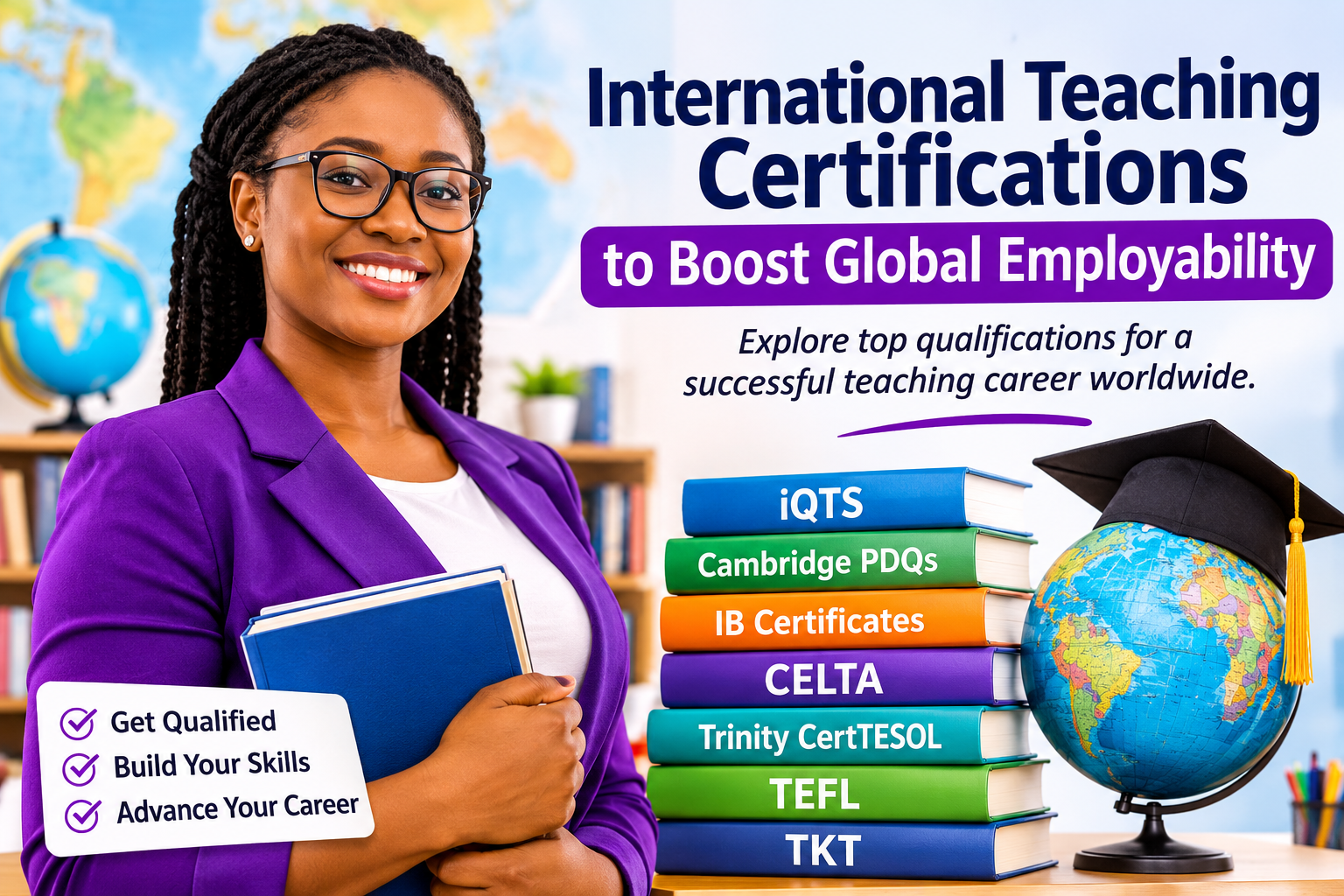
Nigerian teachers seeking international career opportunities can explore several international teaching certifications and professional-development programmes, including iQTS, Cambridge PDQs, IB educator certificates, CELTA, Trinity CertTESOL, TEFL and the Cambridge Teaching Knowledge Test (TKT).
These qualifications serve different purposes: some provide structured teacher training, others support professional development or curriculum knowledge, while some specialise in teaching English to speakers of other languages.
Choosing the right option depends on your career goals, existing qualifications, teaching experience and the requirements of your intended employer or destination country.
Table of Contents
ToggleWhich International Teaching Qualifications Should Nigerian Teachers Consider?
KEY TAKEAWAY
For a formal UK-linked teacher-training route: Consider International Qualified Teacher Status (iQTS), which can lead to English Qualified Teacher Status (QTS) when successfully completed through an approved provider.
For professional development in teaching and learning: Explore Cambridge Professional Development Qualifications, including the Certificate and Diploma in Teaching and Learning.
For schools offering the International Baccalaureate: Investigate IB educator certificates through recognised university programmes.
For teaching English to speakers of other languages: Compare CELTA, Trinity CertTESOL, and reputable TEFL programmes.
For demonstrating knowledge of English-language teaching: Consider the Cambridge Teaching Knowledge Test (TKT), particularly if you want a modular assessment of your teaching knowledge.
It is important to understand that these options are not interchangeable. A professional-development certificate does not automatically qualify its holder for every teaching position. Similarly, no single qualification guarantees employment or permission to work in another country.
Important Note
Always verify current entry requirements, delivery arrangements, and formal recognition of any programme before enrolling. Institutional recognition, professional registration eligibility, and legal work permits are separate matters.
International Qualified Teacher Status (iQTS)
International Qualified Teacher Status (iQTS) is a UK government-backed teacher-training qualification delivered by approved English initial teacher-training providers to trainees outside England. It follows standards aligned with English teacher training and combines professional study with practical classroom experience.
Successful completion through an approved provider leads to English Qualified Teacher Status (QTS), subject to applicable requirements. This makes iQTS different from short online certificates or general professional-development courses.
Who Should Consider iQTS?
iQTS suits graduates who want to become professionally qualified teachers, as well as aspiring educators who want to train while living and working outside England. It may be particularly relevant for those considering employment in schools where English QTS is valued or required.
What Should Nigerian Applicants Check?
Before applying, confirm that you meet the academic and English-language requirements. You should also understand the programme’s school-placement arrangements and practical teaching requirements. In addition, check the approved provider’s fee structure, course schedule, teaching phase, and subject options.
Important Note
Although iQTS leads to English QTS when successfully completed through an approved provider, it does not automatically grant a visa or the right to work in the UK. Teachers planning to relocate must check the professional registration and immigration requirements of their intended destination.
Cambridge Professional Development Qualifications
Cambridge Professional Development Qualifications (PDQs) help teachers and school leaders refine their professional practice. Available focus areas include teaching and learning, educational leadership, teaching bilingual learners, teaching with digital technologies, early years good practice, and classroom practice.
The Certificate in Teaching and Learning focuses on developing and applying core teaching knowledge, while the Diploma supports deeper professional inquiry. Cambridge PDQs involve structured learning and the practical application of ideas rather than simply attending short workshops.
How Can Cambridge PDQs Benefit Teachers?
These qualifications can strengthen lesson planning, assessment design, learner-centred teaching, reflective practice, and pedagogical understanding. They also support professional growth for educators working in schools that use Cambridge curricula.
However, a Cambridge PDQ is not a substitute for an initial teaching qualification or professional licence. Therefore, teachers should confirm specific employer expectations before enrolling.
Who Should Consider a Cambridge PDQ?
This route may suit practising teachers seeking to improve their classroom practice, educators pursuing professional development, and school leaders looking to strengthen instructional leadership.
Review current qualification details and locate accredited providers through Cambridge International’s official website.
International Baccalaureate Educator Certificates
The International Baccalaureate (IB) offers IB educator certificates through recognised university-level programmes. These credentials help educators develop their understanding of IB teaching methodologies, learning frameworks, and educational leadership.
Relevant programmes focus on the Primary Years Programme (PYP), Middle Years Programme (MYP), Diploma Programme (DP), or Career-related Programme (CP). Choose the option that aligns with your target age group and preferred educational framework.
What Can an IB Educator Certificate Demonstrate?
Depending on the specific programme, an IB educator certificate can demonstrate preparation in IB pedagogy, curriculum design, assessment, and professional practice. This may be useful when applying for positions in IB World Schools, although individual schools determine their own recruitment requirements.
Who Should Consider IB Training?
Teachers targeting employment in IB World Schools may benefit from this training because it helps them understand the relevant IB curriculum frameworks before applying for roles.
Always verify admission criteria, delivery formats, and tuition fees directly with the awarding university.
CELTA for English-Language Teaching
The Certificate in Teaching English to Speakers of Other Languages (CELTA), issued by Cambridge English, is designed for individuals pursuing careers in English-language instruction. It combines educational theory with assessed practical teaching experience.
CELTA suits candidates with little or no prior English-teaching experience, as well as experienced educators seeking a formal qualification in this area. The curriculum covers supervised teaching practice, lesson planning, written assignments, and classroom observations of experienced practitioners.
What Jobs May CELTA Support?
CELTA may support applications for positions in language schools, adult education centres, international language institutes, and specialised online teaching platforms.
However, CELTA is not a general teaching credential for mainstream primary or secondary school subjects. Educators wishing to teach Biology, Mathematics, or Primary Science must consider the relevant subject-specific teaching qualifications and requirements.
Trinity CertTESOL
The Trinity Certificate in Teaching English to Speakers of Other Languages (CertTESOL) is another internationally recognised initial qualification for English-language educators. Like CELTA, it combines theoretical foundations with supervised practical teaching experience.
The syllabus develops core competencies in lesson planning, language awareness, pedagogical methods, learner needs analysis, and reflective practice. Candidates complete assessed teaching modules with real learners.
CELTA or Trinity CertTESOL?
Both credentials offer practical preparation for English-language teaching. Rather than choosing based on brand recognition alone, compare authorised providers, course formats, practical teaching structures, total costs, and the preferences of your target employers.
Neither certificate replaces mainstream academic teaching credentials.
TEFL Certificates
TEFL (Teaching English as a Foreign Language) courses are offered by different providers, resulting in variations in quality, assessment standards, and recognition. Some offer basic introductory modules, while others require extensive coursework and monitored teaching practice.
A TEFL certificate may support applications for English tutoring and online teaching roles. However, competitive employers may also require a university degree, verifiable classroom experience, or a more comprehensive initial teaching qualification.
How to Identify a Suitable TEFL Course
Before enrolling, investigate the awarding body, training hours, curriculum content, assessment methods, and tutor support. Also, verify whether practical teaching hours are included and whether your target employers accept the specific certificate.
Caution
Exercise caution with providers promising guaranteed jobs, universal recognition, or unconditional permission to teach worldwide. Always verify such promotional claims independently.
Cambridge Teaching Knowledge Test (TKT)
The Cambridge Teaching Knowledge Test (TKT) consists of modular examinations that assess theoretical knowledge of English-language teaching methodology and professional concepts.
Because TKT assesses theoretical knowledge rather than practical classroom performance, it should not be treated as a full teacher-training qualification or professional licence. Instead, it can serve as a foundational assessment for educators looking to organise and demonstrate their teaching knowledge or prepare for further professional development.
Which Qualification Should You Choose?
The right qualification depends on your target teaching role, existing credentials, and the requirements of your intended employer.
For formal UK-linked teacher training: Investigate iQTS.
For improving general teaching practice: Explore Cambridge PDQs.
For opportunities in IB World Schools: Consider IB educator certificates.
For English-language instruction: Compare CELTA, Trinity CertTESOL, and reputable TEFL programmes.
For assessing theoretical English-language teaching knowledge: Consider Cambridge TKT.
For mainstream international primary or secondary school roles, always check whether vacancies require a recognised teaching licence, a relevant university degree, classroom experience, or familiarity with a particular curriculum.
What Else Do International Schools Look For?
An international teaching certificate represents only one part of a successful application. International schools assess candidates using several factors, including their qualifications, professional experience, and suitability for the role.
Common requirements include:
Recognised Teaching Licences and Degrees: Mainstream international schools may require formal teaching credentials alongside relevant university degrees. A university education degree, a state teaching licence, and a short professional-development certificate are distinct credentials.
Classroom Experience and Curriculum Knowledge: Schools look for proven competence in lesson planning, formative assessment, classroom management, and parent communication. Familiarity with British, American, IB, or Cambridge frameworks may also be relevant.
Safeguarding and Documentation: Expect background checks, knowledge of child protection policies, verified academic transcripts, professional references, and, in some cases, recorded teaching observations.
Final Thoughts
International teaching qualifications can help Nigerian educators improve their professional practice and explore global career opportunities. However, the value of each qualification depends on the teacher’s career goals, the intended role, and the requirements of the target employer.
Before enrolling, verify the qualification through its official awarding body, understand what it does and does not qualify you to do, and check the professional and immigration requirements of your intended destination. This will help you invest in a programme that supports your career plans.
Recent Post
-
Opps, No posts were found.